Quick summary:Under Kenya’s Occupational Safety and Health Act (OSHA 2007) and the updated First Aid in the Workplace Regulations 2024, every employer must provide a stocked, accessible first aid kit, trained first aiders, and pass an annual first aid audit. Non-compliance is a criminal offense enforced by DOSHS. This guide tells you exactly what you need, workplace by workplace.
The Legal Foundation: OSHA 2007 and the 2024 Regulations
Kenya’s workplace first aid obligations are anchored in two key pieces of legislation:
- The Occupational Safety and Health Act, 2007 (OSHA 2007) — This is the principal law governing workplace safety across all sectors in Kenya. It replaced the old Factories and Other Places of Work Act and applies to every workplace, not just factories.
- The Occupational Safety and Health (First Aid in the Workplace) Regulations, 2024, Update — Legal Notice 79 of 2024, gazetted in May 2024. These updated regulations are now the definitive DOSHS first aid requirements for Kenyan workplaces. They replace the older 2024 L.N. 53 regulations and set stricter, more comprehensive obligations on employers.
Both are enforced by the Directorate of Occupational Safety and Health Services (DOSHS), operating under Kenya’s Ministry of Labour and Social Protection. DOSHS carries out workplace inspections, investigates accidents, and issues compliance certificates. You register your workplace at doshmis.go.ke.
⚠️ Important: The 2024 Regulations now apply to all workplaces in Kenya — not just factories. This includes offices, schools, hospitals, retail shops, construction sites, hotels, NGOs, and government institutions. If you employ people, you are covered.
What DOSHS Requires: The 6 Core First Aid Obligations
Under the 2024 Regulations, every employer (referred to as “occupier” in the law) must meet all six of the following requirements:
1. Conduct a first aid needs assessment.
Before selecting a kit or appointing a first aider, the employer must carry out a risk-based assessment of the workplace to determine the appropriate level of first aid provision. A construction site has different needs from an insurance office. The assessment determines the number of first aid kits required, the contents of those kits, and how many trained first aiders are needed.
2. Provide Adequate First Aid Kits
First aid kits must be stocked, accessible, and appropriate for the size and risk level of the workplace. The kit must be kept in a designated, clearly signed location known to all employees. See the required contents list in the next section.
3. Appoint and Train Sufficient First-Aiders
The employer must appoint — in writing — an adequate number of trained first aiders. The 2024 Regulations set specific training and refresher requirements:
- First aiders must hold a valid first aid certificate from an approved training provider
- Refresher training must be undertaken at intervals set by the Regulations
- First aiders must be vaccinated against Hepatitis B
- The names and telephone numbers of all appointed first aiders must be prominently displayed in the workplace at all times
4. Pass an Annual First Aid Audit
This is the biggest change under the 2024 Regulations and the one most businesses are unaware of. Employers must arrange for an annual first aid audit carried out by an approved First Aid auditor. The auditor is then required to submit an audit report to both the employer and the DOSHS Director within 14 days of the audit date. The employer bears the cost of the audit.
5. Inform All Workers
Employers must ensure every employee knows: the location of first aid kits and equipment, the identity and contact details of trained first aiders, and the procedures to follow in a first aid emergency.
6. Keep Records of First Aid Incidents
All first aid incidents must be recorded and kept on file. These records form part of the documentation reviewed during a DOSHS inspection and the annual audit.
DOSHS First Aid Kit Contents—What Must Be Inside?
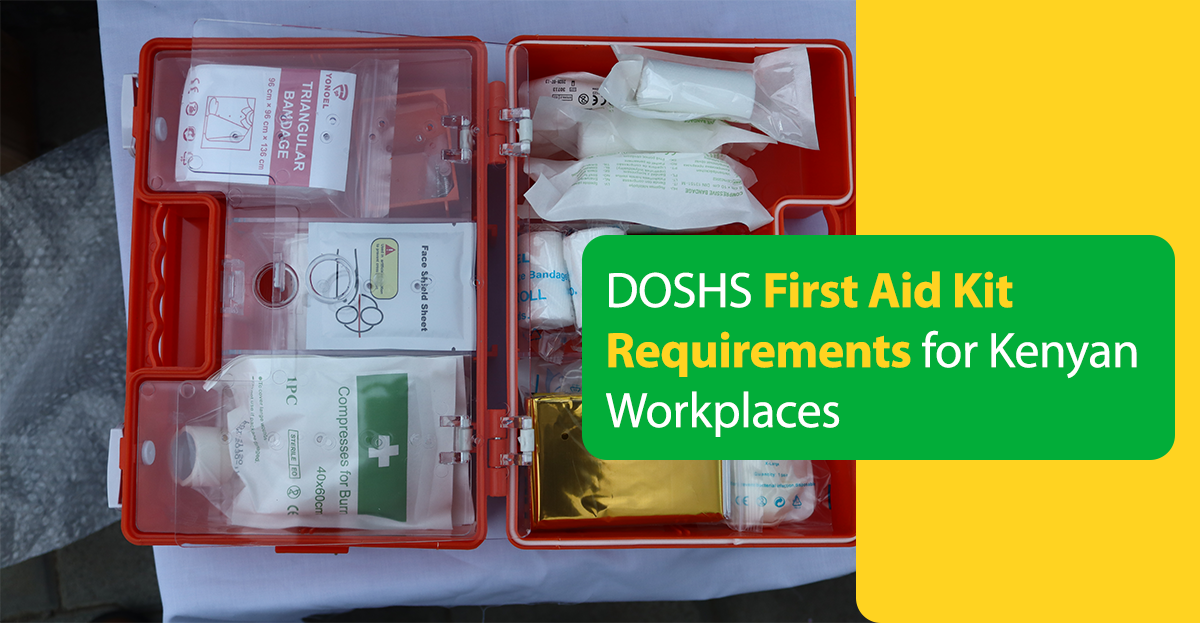
The minimum contents of a compliant workplace first aid kit in Kenya are set out in the Second Schedule of the 2024 regulations. A standard occupational first aid kit must include all of the following:
- Adhesive bandages (plasters) in assorted sizes
- Sterile gauze dressings (various sizes)
- Disposable medical-grade gloves (non-latex option where relevant)
- Antiseptic wipes or antiseptic solution
- Triangular bandages (minimum 2)
- Crepe/elastic bandages
- Scissors (blunt-ended)
- Tweezers/forceps
- Safety pins
- Adhesive tape/micropore tape
- Eyewash solution or sterile eyewash pods
- Space/thermal emergency blanket
- First aid instruction booklet or guide
- Disposable face shield or CPR mask (for workplaces with CPR-trained first aiders)
- Cold compress / instant ice pack
High-risk workplaces (construction, manufacturing, chemicals) must supplement the standard kit with additional items relevant to their specific hazards — for example, burn dressings for kitchens and foundries, or chemical splash eye wash stations near acid handling areas.
“The employer should ensure that a First Aid audit is carried out annually by a competent professional. They also ought to provide all their workers with information on First Aid procedures, the location of First Aid kits, and information on every person trained in First Aid.”
— Occupational Safety and Health (First Aid in the Workplace) Regulations, 2024
Which first aid kit does your workplace need?
Not every workplace needs the same kit. Use this table to identify the right option for your situation—all available from Safety Hub Enterprises:
| Workplace Type | Recommended Kit | DOSHS-compliant? | Price |
|---|---|---|---|
| Personal vehicle/company car | Car First-Aid Kit | ✓ Basic road use | KSh 1,500 |
| Small office (under 25 staff) | General Purpose First Aid Kit | ✓ Low-risk workplaces | KSh 1,800 |
| Home, small shop, or NGO | White Medium First Aid Box | ✓ General use | KSh 2,800 |
| Construction site, recreation centre, school (up to 50 people) | Large First Aid Kit | ✓ HSE / OSHA 2007 compliant | KSh 2,500 |
| Factory, warehouse, hospital, industrial site (50+ workers) | Workers Occupational First Aid Kit | ✓ Fully DOSHS / OSHA 2007 compliant — lockable metal cabinet | KSh 7,500 |
| Family home, sporting event, community group | Universal First Aid Kit | ✓ Meets European standard, covers up to 50 people | KSh 3,500 |
For workplaces with more than 50 employees, the Workers Occupational First Aid Kit is the legally required option. It comes in a lockable, wall-mounted metal cabinet — the format that DOSHS inspectors expect to see in industrial and commercial premises.
What Happens During a DOSHS First Aid Inspection?
DOSHS inspectors can visit your workplace at any time. When they arrive and check first aid compliance, they will typically look for:
- A stocked first aid kit in a clearly marked, accessible location
- Evidence that appointed first aiders exist (written appointment letters on file)
- Displayed names and contact numbers of first aiders
- Valid first aid training certificates for your appointed first aiders
- First aid audit certificate (required annually under the 2024 Regulations)
- First aid incident records / logbook
- Workplace registered on the DOSHS MIS system at doshmis.go.ke
Step-by-Step: Getting Your Workplace First Aid Compliant
Follow this checklist to achieve full DOSHS first aid compliance:
- Step 1: Register your workplace on the DOSHS MIS system — doshmis.go.ke
- Step 2: Conduct a first aid needs assessment based on your workforce size and risk level
- Step 3: Purchase the appropriate first aid kit for your workplace type (see table above)
- Step 4: Mount or install the kit in a clearly signed, accessible location
- Step 5: Appoint at least one first aider in writing; ensure they complete accredited training
- Step 6: Display the first aider’s name and phone number prominently in the workplace
- Step 7: Ensure your first aider is vaccinated against Hepatitis B
- Step 8: Inform all staff of the kit location and first aid procedures
- Step 9: Arrange an annual first aid audit with an approved DOSHS auditor
- Step 10: Keep records of all first aid incidents in a logbook
- Step 11: Restock and replace expired items in your kit regularly — consider a restocking service
How Often Should You Restock Your First Aid Kit?
Under the 2024 Regulations, the employer is responsible for keeping the first aid kit adequately stocked at all times. As a minimum:
- Check your kit every three months for expired or depleted items
- Restock immediately after any first aid incident where supplies were used
- Replace the entire kit contents after 3–5 years even if unused, as adhesives, antiseptics, and dressings degrade
Safety Hub Enterprises offers a first aid kit restocking and refill service across Kenya at competitive prices. We restock your existing kit to keep it DOSHS-compliant without the cost of buying a brand-new kit. Contact us on +254 111 056 220 or WhatsApp +254 727 855 896.
Ready to Buy a DOSHS-Compliant First Aid Kit?
Safety Hub Enterprises supplies the full range of OSHA and DOSHS-compliant first aid kits in Kenya — from KSh 1,500 for a car kit to KSh 7,500 for a fully equipped occupational cabinet.
📞 Call or WhatsApp: +254 111 056 220 | +254 727 855 896
📍 Junction Trade Center, Accra Road, Nairobi — 7th Floor, Room 704
🚚 Same-day Nairobi delivery | 24–48hr nationwide delivery
Frequently Asked Questions — DOSHS First Aid Requirements Kenya
Is a first aid kit legally required for all businesses in Kenya?
Yes. Under the Occupational Safety and Health Act 2007 (OSHA 2007) and the First Aid in the Workplace Regulations 2024, every employer in Kenya is legally required to provide a stocked first aid kit that is accessible to all employees at all times. This applies to all workplaces — offices, factories, schools, construction sites, retail shops, hospitals, and NGOs. Failure to comply is a criminal offense enforced by DOSHS during workplace inspections.
How many first aiders does a Kenyan workplace need?
The number of trained first aiders required depends on your workforce size and the risk level of your workplace as determined by a first aid needs assessment. As a general guide, low-risk workplaces (such as offices) should have at least one appointed first aider per floor or per 50 employees. High-risk workplaces (construction, manufacturing) require a higher ratio. All appointed first aiders must hold valid first aid certificates from accredited training providers and must be vaccinated against Hepatitis B.
What is the penalty for not having a first aid kit in Kenya?
Under Section 109 of OSHA 2007, an employer who fails to comply with first aid requirements commits a criminal offence and is liable upon conviction to a fine or imprisonment. In practice, a DOSHS inspection can result in an improvement notice, requiring you to achieve compliance within a set deadline. Continued non-compliance can lead to a prohibition notice — effectively closing your workplace until the issue is resolved.
What are the new 2024 DOSHS first aid regulations in Kenya?
The Occupational Safety and Health (First Aid in the Workplace) Regulations, 2024 (Legal Notice 79/2024), gazetted in May 2024, replaced earlier regulations and introduced new obligations for Kenyan employers. The key new requirements include: conducting a formal first aid needs assessment; arranging an annual first aid audit by an approved auditor (who must submit a report within 14 days); ensuring first aiders are vaccinated against Hepatitis B; and keeping records of all first aid incidents. These regulations now apply to all workplaces in Kenya, not just factories.
Where can I buy a DOSHS-compliant first aid kit in Kenya?
Safety Hub Enterprises supplies DOSHS and OSHA 2007-compliant first aid kits across Kenya. The Workers Occupational First Aid Kit (KSh 7,500) is the standard-compliant option for industrial and commercial workplaces with 50+ employees — it comes in a lockable metal cabinet suitable for wall mounting. Visit us at Junction Trade Center, Accra Road, Nairobi (7th Floor, Room 704), order online at safetyhub.co.ke/product-category/general-safety/first-aid-kits/, or call +254 111 056 220 for same-day Nairobi delivery.
How do I register my workplace with DOSHS in Kenya?
Employers must register their workplace on the DOSHS Management Information System (DOSHMIS) at doshmis.go.ke. Registration is a prerequisite for compliance with OSHA 2007 and allows DOSHS to maintain a record of your workplace for inspection purposes. After registration, you can apply for a Certificate of Registration, which is required to operate legally as an employer in Kenya.