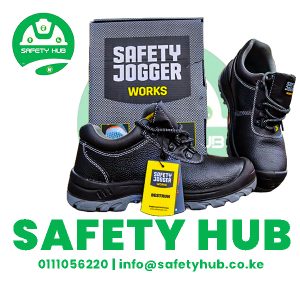
When purchasing safety boots for employees, the appearance of a steel toe cap is not enough to establish whether the footwear meets the required safety standard. Buyers need to understand the protection offered by the footwear, the tests it has undergone, and the certification documents supplied with it.
EN ISO 20345:2022 is an international safety footwear standard that specifies the basic and additional performance requirements for safety shoes and boots used in workplaces. It covers areas such as toe protection, slip resistance, resistance to mechanical hazards, water resistance, and other footwear performance requirements.
For procurement officers, safety managers, construction companies, and factory operators in Kenya, understanding this standard helps when selecting safety footwear for different working environments.
At Safety Hub Enterprises Limited, we supply industrial safety boots and safety shoes for construction, manufacturing, engineering, warehousing, security, and other industries. Our range includes different footwear designs and protection categories to suit different workplace requirements.
What Is EN ISO 20345:2022?
EN ISO 20345:2022 is the European adoption of ISO 20345:2021, which specifies requirements for safety footwear designed for general workplace use.
One of its most important requirements is toe protection. Safety footwear certified under the standard must have a protective toe cap designed to withstand an impact energy of 200 joules and compression of 15 kN.
However, toe protection is only one part of the standard. Footwear is also assessed against applicable requirements covering construction, materials, ergonomics, slip resistance and other protective properties.
The 2022 edition replaced the previous EN ISO 20345:2011 edition and introduced revised testing requirements, updated markings and additional footwear classifications.
Some important changes include:
- Introduction of S6 and S7 footwear categories.
- New classifications for non-metallic penetration-resistant inserts.
- Revised slip-resistance testing and markings.
- Updated requirements for footwear materials and outsoles.
- Changes to water-resistance terminology and markings.
- Additional provisions for customised safety footwear.
These changes matter when purchasing new safety boots because older product descriptions may still use classifications from the previous edition.
What Do the EN ISO 20345:2022 Safety Boot Categories Mean?
Safety footwear is classified according to the protection it provides. The category marked on the footwear helps buyers identify its basic protective properties.
The main classifications include SB, S1, S2, S3, S4, S5, S6 and S7.
1. SB – Basic Safety Footwear
SB represents the basic requirements for safety footwear.
It includes a protective toe cap tested against 200-joule impact and 15 kN compression.
This classification provides basic toe protection but does not automatically include the additional features found in higher categories.
2. S1 – Safety Footwear for Dry Working Environments
S1 footwear includes the basic SB requirements, together with:
- Closed heel area.
- Antistatic properties.
- Energy absorption in the heel region.
S1 safety shoes are commonly considered for indoor workplaces where the main risks involve impact, compression and static electricity.
They are suitable for certain warehouse, assembly and general industrial applications, depending on the workplace risk assessment.
3. S2 – Safety Footwear with Water-Resistant Upper Material
S2 includes all S1 requirements, with additional protection against water penetration and absorption through the upper material.
This makes S2 footwear useful in workplaces where occasional exposure to moisture is expected.
It is important to understand that S2 does not mean the entire boot is waterproof.
4. S3 – Safety Footwear with Additional Penetration Protection
S3 is one of the commonly requested classifications for industrial safety boots.
Under the 2022 standard, S3 combines the requirements of S2 with penetration resistance and a cleated outsole.
The classification is further divided according to the type of penetration-resistant insert:
- S3: Uses a Type P metallic penetration-resistant insert.
- S3L: Uses a Type PL non-metallic penetration-resistant insert.
- S3S: Uses a Type PS non-metallic penetration-resistant insert.
These distinctions are important when choosing between steel and non-metallic midsole protection.
S3 footwear is commonly considered for construction, engineering, manufacturing, workshops and other environments where workers may encounter sharp objects, moisture and uneven surfaces.
5. S4 – Safety Footwear for Polymer-Based Construction
S4 footwear is designed for Class II footwear, generally made from rubber or polymeric materials.
It includes:
- Protective toe cap.
- Closed heel area.
- Antistatic properties.
- Energy absorption in the heel region.
S4 is commonly relevant to fully moulded safety gumboots and other polymer-based footwear.
6. S5 – Polymer Safety Footwear with Penetration Resistance
S5 includes the S4 requirements, together with penetration resistance and a cleated outsole.
The classifications include:
- S5 – Metallic Type P insert.
- S5L – Non-metallic Type PL insert.
- S5S – Non-metallic Type PS insert.
These boots are considered for wet, muddy and demanding industrial environments where both toe and underfoot protection are required.
7. S6 – Safety Footwear with Whole-Footwear Water Resistance
S6 footwear includes the S2 requirements, together with water resistance of the complete footwear.
This is an important distinction between an upper that resists water penetration and a boot designed to provide water resistance throughout its construction.
8. S7 – Safety Footwear with Water Resistance and Penetration Protection
S7 combines S3-level protection with water resistance of the complete footwear.
The classifications are:
- S7 – Metallic Type P penetration-resistant insert.
- S7L – Non-metallic Type PL insert.
- S7S – Non-metallic Type PS insert.
This category is particularly relevant when workers need protection against sharp objects and exposure to wet working conditions.
Difference Between S3, S3L and S3S Safety Boots
One of the changes introduced in the 2022 standard is the distinction between metallic and non-metallic penetration-resistant inserts.
| Classification | Penetration-resistant insert |
|---|---|
| S3 | Metallic Type P |
| S3L | Non-metallic Type PL |
| S3S | Non-metallic Type PS |
Metallic inserts are commonly made from steel, while non-metallic inserts use specially designed materials.
Non-metallic inserts may offer benefits in weight, flexibility and coverage, depending on the footwear design. However, buyers should not assume that every non-metallic insert provides identical protection.
The actual classification and test documentation should always be checked.
What Do the Symbols on EN ISO 20345:2022 Safety Boots Mean?
Apart from the main safety category, footwear may carry additional markings showing specific protective features.
Here are some common markings buyers may encounter:
| Marking | Meaning |
|---|---|
| P | Metallic penetration resistance |
| PL | Non-metallic penetration resistance, Type PL |
| PS | Non-metallic penetration resistance, Type PS |
| A | Antistatic footwear |
| E | Energy absorption in the heel region |
| WPA | Water penetration and absorption of the upper |
| WR | Water resistance of the complete footwear |
| FO | Resistance of the outsole to fuel oil |
| SR | Additional slip-resistance requirement |
| HRO | Resistance of the outsole to contact heat |
| HI | Heat insulation of the footwear |
| CI | Cold insulation of the footwear |
| LG | Ladder grip |
| SC | Scuff cap abrasion resistance |
These markings are useful when matching footwear to specific workplace hazards.
A buyer should also understand that a symbol does not mean the footwear protects against every possible hazard. For example, antistatic footwear is not the same as electrically insulating footwear.
EN ISO 20345:2011 vs EN ISO 20345:2022 – What Changed?
Companies replacing old safety footwear stocks should understand the difference between the previous and revised standards.
| Feature | EN ISO 20345:2011 | EN ISO 20345:2022 |
|---|---|---|
| Main safety categories | SB to S5 | SB to S7 |
| Water-resistant upper | WRU | WPA |
| Whole-footwear water resistance | WR | WR |
| Penetration protection | P | P, PL and PS distinctions |
| Slip resistance | SRA, SRB and SRC markings | Revised requirements and SR marking |
| Additional categories | S6 and S7 not included | S6 and S7 introduced |
The revised standard gives buyers more detailed information about the construction and protective properties of safety footwear.
It is therefore important to check the actual marking on the boot rather than relying only on an older catalogue description.
How to Verify EN ISO 20345:2022 Safety Boot Certification
Before purchasing safety boots in bulk, procurement officers should ask the supplier for supporting technical documentation.
A product description stating S3 or EN ISO 20345:2022 is not, on its own, proof of certification.
The following documents and details should be checked:
1. EU Declaration of Conformity
Where EU PPE conformity is claimed, request the manufacturer’s EU Declaration of Conformity. It should identify the manufacturer, product or model, applicable legislation and relevant standards.
2. Type-examination certificate
For applicable Category II safety footwear under the EU PPE framework, check the EU type-examination certificate issued by an appropriately notified body.
3. Product identification
The model, manufacturer, size and other identification details should correspond with the footwear and supporting documents.
4. Safety category
Check whether the boot is marked SB, S1, S2, S3, S3L, S3S or another applicable classification.
5. Additional protection markings
Confirm that the boot has the additional properties required for the intended workplace.
6. Test documentation
Where necessary, request relevant test reports or technical information to support specific protection claims.
For Kenyan buyers, it is also important to confirm applicable KEBS requirements and the product’s conformity documentation.
Which EN ISO 20345:2022 Safety Boots Should You Buy?
The correct safety boot depends on the hazards workers face.
Here are examples of how different categories may be considered:
| Workplace | Footwear to consider |
|---|---|
| Warehouses and assembly areas | S1 or S1P legacy-rated footwear, subject to current product marking |
| General industrial operations | S2 or S3 |
| Construction sites | S3, S3L or S3S |
| Engineering workshops | S3, S3L or S3S |
| Wet industrial environments | S6 or S7, depending on other hazards |
| Agricultural and outdoor work | S3, S5 or S7, depending on footwear construction and exposure |
These are starting points, not universal specifications. A workplace risk assessment should determine the final footwear requirements.
For example, a construction worker exposed to nails and sharp metal offcuts needs suitable penetration-resistant footwear. A warehouse employee working mainly on dry, clean floors may have different footwear requirements.
Safety Boots Available at Safety Hub Enterprises in Kenya
At Safety Hub Enterprises Limited, we supply a selection of industrial safety boots and safety shoes for individuals, contractors, factories, institutions and corporate procurement departments.
Our collection includes different designs, brands and protection specifications.
Some of the footwear available includes:
Safety Jogger BestBoy and BestRun
Safety Jogger footwear is suitable for buyers looking for industrial safety shoes for construction, workshops, manufacturing and related applications.
The BestBoy S3 and BestRun S3 models are among the options listed in our safety footwear range. Check the individual product documentation and markings for the applicable standard edition and protection classification.
Ace Duma Safety Shoes
The Ace Duma is listed with a 200-joule steel toe cap, anti-puncture steel midsole, slip- and oil-resistant outsole and water-resistant leather upper. The product listing identifies it as made in Kenya to KS ISO 20345:2022.
Ace Mamba S2 Safety Shoes
The Ace Mamba S2 is listed with a 200-joule steel toe cap, antistatic properties and water-resistant leather construction.
It is an option for buyers considering S2-classified industrial footwear.
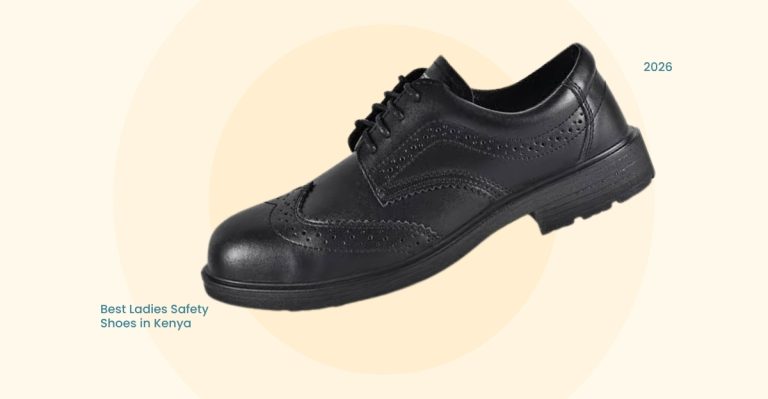
BestGirl Safety Jogger Shoes
For female employees, the BestGirl safety shoes offer a low-cut design and protective features. The product listing includes toe protection, penetration resistance, antistatic properties and water-related protection claims.
Buyers should confirm the exact model certification documents when placing an order.
View our full range of industrial safety footwear here:
https://www.safetyhub.co.ke/product-category/safety-boots/
Why Buy Safety Boots from Safety Hub Enterprises?
Safety Hub Enterprises Limited supplies safety boots and industrial footwear to businesses across Kenya.
Our safety footwear range caters to different budgets, industries and workplace requirements.
We serve:
- Construction and engineering companies.
- Manufacturing plants and factories.
- Warehouses and distribution centres.
- Security companies.
- Agricultural businesses.
- Workshops and maintenance teams.
- Government institutions and contractors.
We also handle bulk orders for companies purchasing safety footwear for their employees.
Customers can contact our team for product specifications, available sizes, quotations and delivery arrangements.
For organisations purchasing several pairs, we recommend submitting a size breakdown and confirming the required footwear classification before placing the order.
Frequently Asked Questions About EN ISO 20345:2022
1. What does EN ISO 20345:2022 mean on safety boots?
It means the footwear is claimed to meet the requirements of the 2022 edition of the safety footwear standard. The applicable certification and conformity documents should be checked to verify the claim.
2. What is the difference between S1 and S3 safety boots?
S1 footwear includes a protective toe cap, closed heel area, antistatic properties and heel energy absorption. S3 adds water penetration and absorption requirements for the upper, penetration resistance and a cleated outsole.
3. Are S3 safety boots waterproof?
S3 footwear has requirements for water penetration and absorption of the upper, but this does not mean the entire boot is waterproof. S7 adds whole-footwear water resistance.
4. What is the difference between S3 and S3S?
Both offer S3-level protection, but S3 uses a metallic Type P penetration-resistant insert, while S3S uses a non-metallic Type PS insert.
5. What does 200 joules mean in safety footwear?
It refers to the impact energy used in testing the protective toe cap. Safety footwear under EN ISO 20345 must also meet a compression requirement of 15 kN.
6. Are steel toe boots better than composite toe boots?
Neither is automatically better in every workplace. Steel and composite toe caps can both meet the required safety performance when properly tested and certified. Buyers should consider weight, workplace conditions, comfort and other requirements.
7. Can antistatic safety boots protect against electric shock?
No. Antistatic footwear reduces the build-up of electrostatic charge under specified test conditions. It should not be treated as electrical insulating footwear. Workers exposed to electrical hazards require footwear specifically tested and certified for the relevant electrical protection.
8. Where can I buy EN ISO 20345 safety boots in Kenya?
Safety Hub Enterprises Limited supplies industrial safety boots and safety shoes in Nairobi, Kenya. Visit our online safety boots catalogue to view available models or contact our sales team for bulk quotations.
Buy Industrial Safety Boots in Kenya from Safety Hub Enterprises
Choosing the correct safety footwear starts with understanding the hazards employees face and the protection each footwear classification provides.
At Safety Hub Enterprises, we supply industrial safety shoes and boots for businesses looking for practical workplace footwear solutions.
Whether you need S3 safety boots for construction workers, S2 footwear for industrial operations or safety shoes for warehouse employees, our team can help you identify suitable available models.
Browse our safety boots collection or contact us for a quotation.
Safety Hub Enterprises Limited
Website: https://www.safetyhub.co.ke/
Safety Boots Catalogue: https://www.safetyhub.co.ke/product-category/safety-boots/
Telephone: +254 111 056 220
WhatsApp: +254 727 855 896
Location: Junction Trade Centre, 7th Floor, Nairobi, Kenya.